Sunday, February 12, 2012
Milestone
Yesterday marked the 9th anniversary of our arrival in PNG. We are grateful to God for His call on our lives, his grace in providing a place of service and his strength that keeps us going. We are grateful to each of you who supports us, through your prayers, through your giving to the World Evangelism Fund, or your help in other ways. We love PNG, and we love you.


Who Came To Church Today?
This morning we attended the Tumba Church of the Nazarene. Our friends, Pastors Kopi and Elis were away, preaching somewhere else.
So, who came to church?


So, who came to church?

Judy Bennett, and volunteer doctor Jennifer Jung, among others.

This nice dog. Two other dogs came to church, but they didn't stay in their pew, and didn't pay attention to the service, but roamed around and left early.

One of the church members who preached (I suspect for the first time--she seemed pretty nervous) in the place of Pastor Elis or Pastor Kopi. The sermon ran about 5 minutes, and was entirely in the local tribal language, which we don't understand.

These cute little girls who weren't afraid of Dr. Jeniffer like they usually would have been of new people.

A boy wearing a shirt with this great graphic, and the name of our new province, "Jiwaka".

Michael Kopi and his guitar.

This cute little girl and her big cousin.

This cute little girl, and a nice old grandpa.

This not-so-young new mama, and her newly-adopted baby.

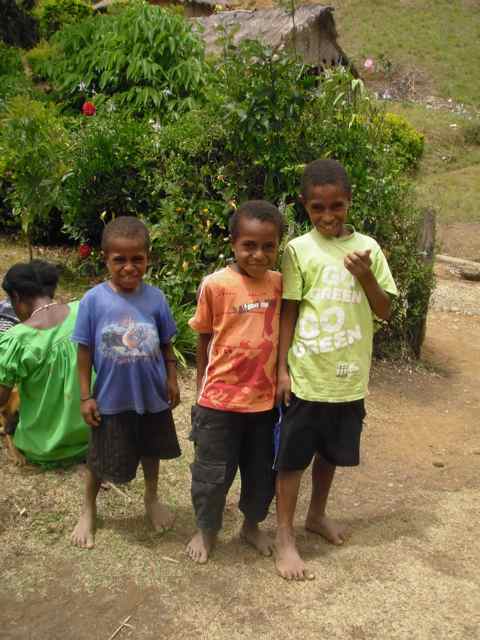
These little boys.
I trust that each of you will find a place to worship this Lord's day. It may be a fancier building, or no building at all. You may worship wearing fine clothes, or simple clothes. You may find that you dog isn't really welcome. There may be preaching in a language you understand, or one that you don't (although it's good to understand). The sermon may be long or short (although I like short ones when I can't understand the language). The preacher may be experienced and confident, or new to the pulpit and scared stiff. But if you come prepared to hear God's word (preached, communicated through songs or testimony, or direct to your heart), and to give worship to Him, you will know that you've been to church.
AB
Saturday, January 28, 2012
Another Flower
A couple of years ago I had a Saturday afternoon project of photographing every kind of flower in our yard. In a couple of hours, I took (as I recall) over a hundred photos of about 80 kinds of flowers. Then I posted them on Facebook, here.
A few days ago I saw a flower that I hadn't noticed before. It's the flower of the passion fruit that is pretty common here, localled called "suga frut". It's a pretty spectacular flower, almost 3 inches across. When I got up close with my camera, I saw the bee who was harvesting nectar inside.

A few days ago I saw a flower that I hadn't noticed before. It's the flower of the passion fruit that is pretty common here, localled called "suga frut". It's a pretty spectacular flower, almost 3 inches across. When I got up close with my camera, I saw the bee who was harvesting nectar inside.

AB
Wednesday, January 25, 2012
The Big Present
It was just a couple of weeks after Christmas when we received this big package from Nazarene Hospital Foundation.

It was quite a bit larger than most of the presents that any of us received at Christmastime this year. In fact, it was larger than any present we'd ever gotten from NHF. Although some of us had not taken down our trees, this box wouldn't fit under any of them. We had to put it under a really tall tree up by the warehouse.
Many of you know that NHF in a ministry headed by Dr. Todd Winter in Medford, Oregon. It's mission is "to support the ongoing work of Kudjip Nazarene Hospital in Papua New Guinea through the collections of medicine, medical supplies, equipment and cash donations." They collect much-needed medical supplies and equipment, and ship it to us several times per year. There were items from this container that were in use before the day was out.
The day that a container arrives is always exciting for us, as it often means the relief of at least some of the shortages that we have been dealing with. It means that we can serve the people of the PNG highlands even better. But this one was an especially big deal, because it was a 40-foot container, the first one ever sent by NHF. They usually send a 20-foot container. Judy is in charge of the medical storeroom, and is responsible for receiving, unloading, and distributing or storing the supplies and equipment that arrive. For weeks she had been clearing out her various storage areas in anticipation of this day. We usually only know approximate arrival times, so she is on edge for several days!
 When the container arrives, Judy calls together "her men". No, I don't worry about her having a lot of men--these are faithful hospital staff and a few missionaries who come to do the hard work of unloading. This time, since it came on a Saturday, I could be one of her men!
When we first open the door of the container, we have to be careful. Like the flight attendant always reminds you, some items may have shifted. This time nothing fell out!
Many of you will recognize missionary Jeff Myers, getting that critical first box off the load.
 Some of you may remember Apa, about whom I posted a couple of years ago. That's him in the black shirt and the shaved head. They are still having to be careful about not letting things fall.
 Each item is labeled. As each one is unloaded, Judy calls out the orders as to where it should go: "Container 1" (she has 3 containers used as storage space), "Pharmacy" (this one goes on a truck that will ultimately haul several loads of medicines), "Storeroom" (these are items that need to be sorted, but that will be put into use in the immediate future--they go on another truck). The relay of helpers moves them to their destinations.
And that's MK Ethan Myers with his back to the camera. Strong kid, big help!
 Heavier items need a team effort. Here a crate of surgical instruments is unloaded.
 And here comes a new anesthesia machine! That's a big deal!
 Even with a team, we didn't try to carry this one very far! We moved it from the container onto a truck, and then backed up to the warehouse. That's my "concentrating real hard" mouth. You know I'm focused when you see that. And that's Jeff, telling me what to do. Of course, that's what I needed.
Thanks to Todd and his crew of helpers in Oregon for all the work involved in collecting, packing and loading all of this. And thanks to all of you who donated supplies or funds to NHF. If you want to get involved, see their website at this link.

It was quite a bit larger than most of the presents that any of us received at Christmastime this year. In fact, it was larger than any present we'd ever gotten from NHF. Although some of us had not taken down our trees, this box wouldn't fit under any of them. We had to put it under a really tall tree up by the warehouse.
Many of you know that NHF in a ministry headed by Dr. Todd Winter in Medford, Oregon. It's mission is "to support the ongoing work of Kudjip Nazarene Hospital in Papua New Guinea through the collections of medicine, medical supplies, equipment and cash donations." They collect much-needed medical supplies and equipment, and ship it to us several times per year. There were items from this container that were in use before the day was out.
The day that a container arrives is always exciting for us, as it often means the relief of at least some of the shortages that we have been dealing with. It means that we can serve the people of the PNG highlands even better. But this one was an especially big deal, because it was a 40-foot container, the first one ever sent by NHF. They usually send a 20-foot container. Judy is in charge of the medical storeroom, and is responsible for receiving, unloading, and distributing or storing the supplies and equipment that arrive. For weeks she had been clearing out her various storage areas in anticipation of this day. We usually only know approximate arrival times, so she is on edge for several days!

When we first open the door of the container, we have to be careful. Like the flight attendant always reminds you, some items may have shifted. This time nothing fell out!
Many of you will recognize missionary Jeff Myers, getting that critical first box off the load.


And that's MK Ethan Myers with his back to the camera. Strong kid, big help!


Thanks to Todd and his crew of helpers in Oregon for all the work involved in collecting, packing and loading all of this. And thanks to all of you who donated supplies or funds to NHF. If you want to get involved, see their website at this link.
AB
Thursday, December 8, 2011
1090
No, that's not a date. Well, it is, but as a date that number is not the subject of this post. 1090 mililiters. That's over a quart, for those who need to know it in those terms. Not a lot of liquid, really, depending on the context. 1090 ml of gasoline would take most cars only a few miles. 1090 ml of warm water would be enough to wash your face. 1090 ml of bloody serum in a man's pericardium can be the difference between life and death.
 I don't often get into medical detail here, but you need to know that the pericardium is the membranous sac that surrounds each of our hearts. It is normally a pearly color, smooth, with just a bit of moisture inside to allow the heart to slide smoothly under it as it beats. But Joseph's pericardium has turned against him. Swollen, red from the tuberculosis that spread there from the surrounding lung. Over the last few weeks, he had become increasingly short of breath, and weaker. As the inflammation of the pericardium increased, serum began to ooze from it's inner surface, and blood began to leak from its now-engorged capillaries. As the fluid built up, it began putting pressure on the heart. More and more, the heart could not fill adequately between contractions, so the amount of blood it could pump diminished. Joseph's blood pressure decreased. Any movement became an exhausting exertion.
Joseph went to the nearby clinic in his village. A few days of amoxicillin did nothing to reverse the relentless progress of the TB. Finally, Joseph's relatives realized that he was dying. They found someone who would drive them to a nearby government hospital. There they were told that there were no doctors to see him. In PNG, it is the privilege of all senior doctors to take "Festive Season Holiday"; basically 2 months off. The junior doctors who are supposed to keep things going want to be like the senior doctors, so they take some time off, too. Joseph's family headed toward Kudjip.
When they brought Joseph into the ER, I was working on another man. I saw that the nurses were checking him. One asked to use my pulse oximeter. This showed that Joseph's blood was carrying adequate oxygen. I did not fully appreciate just how sick he was. I listened to his lungs and heard good air movement, so I left him for the nurses to "screen". He was making a lot of noise, and I thought maybe he was just being dramatic. A little while later, the nurse told me that Joseph was ready to be seen. I examined him more carefully this time, but didn't find anything specific, except that his heart beat was rapid and soft. I ordered a chest x-ray.
Some time later, I was informed that his x-ray was ready. Here it is:
 For those of you who don't know what you're looking at, suffice it to say that it's not OK. I went and got the ultrasound machine. It showed me that most of the volume of what appears to be the heart on the chest x-ray was fluid. The heart was barely contracting under the pressure that surrounded it. There was also a fair amount of fluid in the right pleural space, the space between the lung and the chest wall. There are many things that can cause this, but here, most of the time, it's TB.
By this time all of the patients in the Outpatient Department had been seen, and doctors were starting to home. I felt that we needed to drain some of that fluid out of the pericardium, but I'd never done it before. I knew that Dr. Erin Meier had done several, but she had left. I found Dr. Steph Doenges, who is on call this evening. She had helped on a pericardiocentesis once. She agreed with my idea of involving Erin. After sever failed attempts, I reached Erin, who came right in. The three of us began to assemble supplies. It was decided that since I had never done or even helped with one before, that I should be the one to do this. This may seem like backward logic to some of you, but it makes complete sense to us.
 Erin held the probe for the ultrasound that would guide my needle into the pericardial space. I use an intracath, usually used as in intraveneous catheter. This is a plastic tube around a steele needle. We found a nice long one. I washed his chest with an iodine solution. Ering guided the ultrasound as I guided the needle into his chest. The needle appeared in the image. I slipped the steel needle out of the plastic sheath, and connected a syringe. As I pulled the plunger, dark, bloody fluid filled the syringe. 20 ml. They say that many times you only need to remove a few ml from the pericardium in order to make the patient much better. The patient didn't look any better. I tried connecting some IV tubing so we could just let it run, but the blood was too thick, so I went back to the syringe. Syringeful after syringeful came out, and was emptied into a nearby basin. When the fluid wouldn't come any more, we'd reposition the catheter. We worried that a random movement by me or by the patient would dislodge it, so Steph put on sterile gloves to hold it. The patient's relative counted syringefuls, and totaled the volume.
 "Wow, we're past 100 ml!" one of us commented.
A few minutes later, "hey, that's almost 500!."
Then Joseph began to quiet. With her free hand, Steph felt his pulse. "Stronger", she said. We could see the movement of the heart on the ultrasound screen returning to normal.
Joseph began to talk to us. Erin and Steph asked him about his wife and children. A boy and a girl, ages 5 and 3. The brother and I were counting and adding. The tally was nearing 1000 ml. A liter! Now we began to have to manipulate the catheter more often, but still the flow came.
At some point someone (yes, it was me--the mood was much lighter as we watched Joseph improve from moment to moment) began to speculate as to whether the Guiness Book of World Records had a category for the largest volume of fluid removed in a pericardiocentesis. Probably not.
 We help people all day long. And once in a while, with God's help, we do we have the opportunity, despite our limited equipment, supplies, and experience, to save a life. Sometimes in a critical situation there isn't anything we can do, and that is miserable. But often it goes well, and a life is saved. That's really a lot of fun!
Thanks to Dr. Steph for her photos!

Joseph went to the nearby clinic in his village. A few days of amoxicillin did nothing to reverse the relentless progress of the TB. Finally, Joseph's relatives realized that he was dying. They found someone who would drive them to a nearby government hospital. There they were told that there were no doctors to see him. In PNG, it is the privilege of all senior doctors to take "Festive Season Holiday"; basically 2 months off. The junior doctors who are supposed to keep things going want to be like the senior doctors, so they take some time off, too. Joseph's family headed toward Kudjip.
When they brought Joseph into the ER, I was working on another man. I saw that the nurses were checking him. One asked to use my pulse oximeter. This showed that Joseph's blood was carrying adequate oxygen. I did not fully appreciate just how sick he was. I listened to his lungs and heard good air movement, so I left him for the nurses to "screen". He was making a lot of noise, and I thought maybe he was just being dramatic. A little while later, the nurse told me that Joseph was ready to be seen. I examined him more carefully this time, but didn't find anything specific, except that his heart beat was rapid and soft. I ordered a chest x-ray.
Some time later, I was informed that his x-ray was ready. Here it is:

By this time all of the patients in the Outpatient Department had been seen, and doctors were starting to home. I felt that we needed to drain some of that fluid out of the pericardium, but I'd never done it before. I knew that Dr. Erin Meier had done several, but she had left. I found Dr. Steph Doenges, who is on call this evening. She had helped on a pericardiocentesis once. She agreed with my idea of involving Erin. After sever failed attempts, I reached Erin, who came right in. The three of us began to assemble supplies. It was decided that since I had never done or even helped with one before, that I should be the one to do this. This may seem like backward logic to some of you, but it makes complete sense to us.

 "Wow, we're past 100 ml!" one of us commented.
A few minutes later, "hey, that's almost 500!."
Then Joseph began to quiet. With her free hand, Steph felt his pulse. "Stronger", she said. We could see the movement of the heart on the ultrasound screen returning to normal.
Joseph began to talk to us. Erin and Steph asked him about his wife and children. A boy and a girl, ages 5 and 3. The brother and I were counting and adding. The tally was nearing 1000 ml. A liter! Now we began to have to manipulate the catheter more often, but still the flow came.
At some point someone (yes, it was me--the mood was much lighter as we watched Joseph improve from moment to moment) began to speculate as to whether the Guiness Book of World Records had a category for the largest volume of fluid removed in a pericardiocentesis. Probably not.

Thanks to Dr. Steph for her photos!
AB
Sunday, November 27, 2011
My First PNG Friend

When I came to PNG, I was anxious to meet Tarp again. When I asked around, I learned that he had been a pastor and an educator. I even learned that our neighbor Tundai Goma was his little sister. Our paths didn't cross for some time, but eventually I had a chance to visit with him briefly.
This morning, I attended the graduation of Melanesia Nazarene Bible College. Among the graduates were members of the first class of a new Master in Ministry program. This is an extension program from Asia Pacific Nazarene Theological Seminary in Manila, Philippines. I knew that some of my friends would receive their Master's degrees (that was a big part of why I was there). Tarp was one of the Masters graduates. I visited with him briefly, and had someone take a quick photo.
The kina shell hanging from his neck is not part of the MNBC graduation regalia: it's a traditional PNG symbol of honor and prosperity, and was given to him by his daughter Grace, as he stepped off the platform after receiving his diploma. Grace serves as secretary to the national board of the Church of the Nazarene in PNG, and works here at Kudjip.
In a few days, I'll tell you more about the graduation.
AB
Wednesday, November 23, 2011
Baby Allen Has A Name
In PNG, babies are often not named for several weeks after birth. Most babies are named by the time they are about 6 weeks old. Once in a while it takes longer. The reason for this isn't completely clear to me, but it may be that in the country with the highest infant mortality rate in the Pacific, and one of the highest in the world, people wait to see if the new one will survive or not. Maybe, without a name a baby seems less like an individual, and it is easier, or people anticipate that it will be easier, if the baby dies.
 I've seen the parents of babies with and without names watch their babies die. Believe me, it doesn't make it any difference if the little one has a name or not.
Or maybe the reasons are lost in antiquity, and now it's just the custom. Sometimes, however, a specific reason comes to light.
A few weeks ago, I cared for a little one on the ward. He was listed on the chart simply as "B/O Anna"--Baby of Anna. He was almost 6 months old, so I asked his mom why he didn't have a name. Her answer stunned me. "His father has left and is with another wife. He doesn't care about us."
"Well, he needs a name," I replied.
"You can give him a name."
When I looked up at her eyes in surprise, I knew that she meant it.
"Really? You want me to give him a name?"
"Yes."
"I'll have to think and pray about it."
To be honest, I didn't think about it much. When I have been in a similar position before, a name turned up in by Bible reading the next day that I suggested. Other times there was an immediate inspiration, like a medical student, or a volunteer from America. There is a little Christiana, named after our recent student. But no name turned up in my readings for the next couple of days, and no other ideas presented themselves.
The next time I saw him on the ward, and thought about it, I got an inspiration.
"My father's name is Allen. He is a good, kind man, a man of God."
"Alright."
And so it was settled. The little one was Allen. I took a photo of him, and after a couple more days he was well enough to be discharged. There were several photos of moms and babies on my camera, and when I downloaded photos a few weeks later, I couldn't remember the significance of the cute little guy with the pretty young mom. Just one more CLK, a cute little kid.
 Then a few days ago, I was doing rounds, and saw a newly-admitted baby. His name was Allen. "Oh," I said. "My father's name is Allen."
"Yes", the young mother replied, "you gave him his name."
I was embarrassed not to have recognized them, but if you saw as many cute babies as I do all day every day, you'd understand.
He had a mild pneumonia. He wasn't as sick this time as last time, and was able to go home after just a few days. I remembered to get another picture this time, which helped me sort out which picture was him before. You can see that he has grown and thrived.
Bless you, little Allen. I pray that you grow to be the man that your namesake is.

Or maybe the reasons are lost in antiquity, and now it's just the custom. Sometimes, however, a specific reason comes to light.
A few weeks ago, I cared for a little one on the ward. He was listed on the chart simply as "B/O Anna"--Baby of Anna. He was almost 6 months old, so I asked his mom why he didn't have a name. Her answer stunned me. "His father has left and is with another wife. He doesn't care about us."
"Well, he needs a name," I replied.
"You can give him a name."
When I looked up at her eyes in surprise, I knew that she meant it.
"Really? You want me to give him a name?"
"Yes."
"I'll have to think and pray about it."
To be honest, I didn't think about it much. When I have been in a similar position before, a name turned up in by Bible reading the next day that I suggested. Other times there was an immediate inspiration, like a medical student, or a volunteer from America. There is a little Christiana, named after our recent student. But no name turned up in my readings for the next couple of days, and no other ideas presented themselves.
The next time I saw him on the ward, and thought about it, I got an inspiration.
"My father's name is Allen. He is a good, kind man, a man of God."
"Alright."
And so it was settled. The little one was Allen. I took a photo of him, and after a couple more days he was well enough to be discharged. There were several photos of moms and babies on my camera, and when I downloaded photos a few weeks later, I couldn't remember the significance of the cute little guy with the pretty young mom. Just one more CLK, a cute little kid.
 Then a few days ago, I was doing rounds, and saw a newly-admitted baby. His name was Allen. "Oh," I said. "My father's name is Allen."
"Yes", the young mother replied, "you gave him his name."
I was embarrassed not to have recognized them, but if you saw as many cute babies as I do all day every day, you'd understand.
He had a mild pneumonia. He wasn't as sick this time as last time, and was able to go home after just a few days. I remembered to get another picture this time, which helped me sort out which picture was him before. You can see that he has grown and thrived.
Bless you, little Allen. I pray that you grow to be the man that your namesake is.
AB
Subscribe to:
Posts (Atom)

